










Home - Oregon Anglers


The common sense political voice

of sports fisherman (and women too)!

Oregon Anglers was formed to find ways to meet the needs of both the state's diverse wildlife, and the practical and economic needs of the communities that depend on the fishers and hunters.

Those of us in the conservation-oriented community need to consider the needs of both the increasing human population and that of all the various species with which we co-exist. We believe that there is adequate room to compromise, and come up with a "win-win" consensus that can help wildlife thrive, yet not destroy the economies of Oregon's communities.

We have carried this message into the development of the Native Fish Conservation Policy, the Hatchery Management Policy, the newly completed statewide Comprehensive Conservation Policy, and the ongoing Coastal Coho Recovery Team. Our representatives are involved with the Oregon Hatchery Research Center's Advisory Committee, the Ocean Sportsfishing Advisory Committee, The Pacific Fisheries Management Council ( Groundfish Advisory Panel), the Salmon Trout Advisory Committee, and the Nearshore Management Plan, the Coho Recovery Plan,  the Lower Columbia Recovery Plan, the Upper Willamette Recovery Plan, the Strategic Conservation Plan, the Pineped Interaction Task Force, marine reserve siting, andwave energy committees. No other fishing group in this state can boast of such widespread involvment!

We believe that we, as anglers, share a bountiful resource with other citizens of this state, and we can co-exist by working together toward our common goal: plentiful and self-sustaining wildlife for all.

Our all-volunteer group participates in all the above mentioned state and federal endeavors. Our affiliated clubs cover a wide range of interests, but all believe in the concept of strength in numbers, and helping one another out.

With this we have become a strong presence in the federal and state planning- and in the State Legislature and U.S. Congress. We have several volunteer state lobbyists, and through the Recreational Fishing Alliance, a strong lobby in Washington D.C.

If you think we are on the right track join our all volunteer effort, with either you time or contributions.

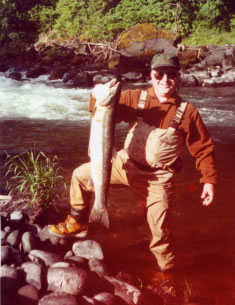
40-inch, 20+ lb. (10Kg) hatchery summer
steelhead caught in July 2001 on the Sandy River

___

OUR MISSION

The purpose of Oregon Anglers is to further the interests of present and future generations of recreational anglers in our state.

OUR GOALS

  1. We promote the interests of Oregon's sports fishing community by taking a proactive role in government affairs.
  2. We promote policies and practices that improve and sustain the health of fish habitats and watersheds.
  3. We work to ensure that hatchery and wild fish management is based on sound scientific research using genetics and current technology. (See the Oregon Hatchery Research Center)
  4. We work to increase the opportunity for angler success. Mitigation is a part of that success.

______________

OREGON ANGLERS BELIEVES:

  1. We can optimize hatchery programs to enhance fisheries, mitigate for lost or natural production, and conserve species at risk of extinction. To bring our hatcheries up-to-date we must fund these improvements.
  2. Accurate ocean surveys of stocks and spawning and rearing areas are urgently needed. Without this information, any recovery efforts are only aimed at harvest, which is just one of the keys to recovery. Mapping our territorial sea (out to 3 miles from shore) is a key part of this goal. To date the legislature has not deemed to fund the completion of this. Any marine reserves are pointless without a survey of what our nearshore waters actually contains.
  3. Warm water species are here to stay, whether they were intentionally introduced or not. We must manage these species as we do salmon, trout, and ocean stocks.
  4. Habitat restoration and protection remain a top priority.
  5. We can facilitate de-listing of fish species under state and federal endangered species laws. There are recovery tools available not being used.
  6. Management of our watersheds must be made basin-by-basin, instead of a "one size fits all" set of rules. Watershed Councils should be held accountable for the money they receive.
  7. We must increase local involvement in fish conservation programs.
  8. We must provide a scientific basis for conservation. Planning for our basins cannot be done on the "Old assumptions and generalities" based on old and inaccurate science.
  9. The human factor must always be considered when planning for wildlife. Economic considerations are an important step in reaching success.
  10.  Large scale poaching and other destruction of our natural resources must be appropriately punished. Upgrading these egregious acts to mandatory prosecution status is being addressed in a bill in the 2009 legislative session, with the Oregon Hunters Association, Trout Unlimited, The Oregon State Police, ODFW, and the Audabon Society joining us. The key is MANDATORY economic penalties and suspensions of fishing and hunting privileges, plus ODFW can pursue civil suits to be reinbursed for the value of the fish or game lost.


You can help Oregon Anglers make
a difference for the future!

To join the ever growing number of anglers who are uniting to save our sport fishing, go to the "JOIN US" page.

_______________________________

For updates on: the International Pacific Halibut Commission meeting results and how it affects Oregon,

 the Upper Willamette Recovery Plan,

or the Governor's "Marine Reserves"

go to the POLICIES page.

________________________________________

In the Columbia River

Sea Lions vs fishermen

Since 1999 the California sea lions at Bonneville have

had their way with spring salmon and steelhead runs. Now

in 2009 they have arrived in even greater numbers.

Now we can begin to even the score!

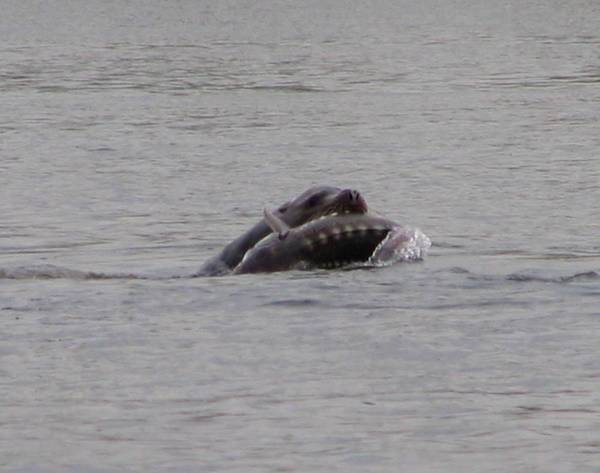
An endangered Stellar Sea lion gobbles a sturgeon in the Columbia River.

      It's bad enough when the California Sea Lions eat a prodigious amount of wild steelhead and salmon, and threaten anglers. This picture shows that sturgeon are being targeted by the Stellar Sea Lions, which are listed as threatened under the Endangered Species Act.  " These Stellars , however, had responded to the non-lethal deterrents used to stop the slaughter of the spring salmon. This year they have changed their tactics by moving right back in when the hazing boats go away. Not only that, but they are now hunting sturgeon in packs instead of individually as before. This enables them to kill and eat the larger spawners.

But we have won in the courts to export, or use lethal methods with the California Sea Lions who are eating the most salmon.

     Oregon, Washington, and Idaho Fish and Game Departments  jointly petitioned NOAA Fisheries to use lethal force on the worst California Sea Lion (CSL) offenders below the Columbia River's Bonneville Dam in the immediate raceway. The California variety of the sea lions are the primary consumers of the spring salmon and steelhead, with 97% of their diet in the river being Salmonids. NOAA convened the "Pineped Interaction Task Force" to deal with the questions surrounding permission to lethally take the most problematic individuals. Dennis Richey, Executive Director of Oregon Anglers, represented the sport fishermen in the 3 states.

NOAA has published it's reports. Go to www.nwr.noaa.gov/ and click on the Sea Lion heading. It will give you the summary. Or check out the updates sent to members of the Scientific Advisory Team on our

To date, all non-lethal efforts to deter the fish slaughter below the dam have failed miserably, and cost the states hundreds of thousands of dollars. They have tried a variety of harassment measures (underwater firecrackers or seal bombs, shotgun shells , underwater playback of orca sounds, etc.), aversive conditioning (dead steelhead treated with an emetic to make them ill), vessel chase, blunt tipped arrows and rubber shotgun pellets, exclusion (physical barriers at fish ladders), and capture and relocation. None worked for very long.

 The courts overruled the objections of the U.S. Humane Society, and granted permission to take up to 85 California Sea Lions (CSLs) per year. 85 CSLs per year sounds like a lot, but the CSL population was about 30,000 in 1976 when the Marine mammal Act went into effect. Today a conservative estimate is that the CSL population is over 300,000, a tenfold increase. The population appears to be growing at about 7% per year. Biologists determined the Potential Biological Removal level  or PBR, which is the the sustainable level of human caused mortality allowed under the Marine Mammal Act is 8,333. The states are asking to use only 1% of that amount in bringing the crisis at Bonneville under control. Reality is that we will be lucky to take about 30 per year because we are constrained by methods, time, and money available.

The majority of the CSL group that is arriving at Bonneville earlier every year is big males trying to gain as much weight and strength as possible before leaving in June for the breeding grounds down south. C404, the infamous big male who has learned to get into the fish ladders, and has taught a few of his cronies to do the same, was caught down at Astoria last spring before he came up river. He weighed in at about 585 pounds. He was caught again on his way to California in mid June and he then weighed almost 1,100 pounds, effectively doubling his body weight in 10 weeks. Tell me they only eat 3 or 4 fish a day to survive!

 It is our belief that we are not dealing with with a natural system. The balance of nature has been thrown out of whack by the over protection of many of the fish's  predators , which has allowed them to reach all-time populations highs (California Sea Lions, Harbor Seals, Arctic Terns, Cormorants, etc.) Once man has begun managing the system, it is inherent for us to continue our stewardship of the balance of nature. We must keep these predators under reasonable levels!

See recent reports on our POLICIES page,

or go to ODFW's site: www.dfw.state.or.us/fish/SeaLion/index.asp

Help in our fight to control all predation on our salmon and steelhead by joining Oregon Anglers. For Oregon taxpayers contributions are a tax credit.

That means it counts as taxes paid!

Go to the Join Us page

by Dennis Richey

 
TASK FORCE RECOMMENDS LETHAL REMOVAL OF CALIFORNIA SEA LIONS
Posted on Friday, November 02, 2007 (PST)

 
An 18-member "Pinniped-Fishery Interaction Task Force" this week voted by an 17-1 margin to recommend approval of an application from the states of Idaho, Oregon and Washington for authority to lethally remove California sea lions that feast each spring on salmon and steelhead returning to the Columbia River.

That recommendation will be forwarded to the NOAA Fisheries Service, which would ultimately decide whether or not to approve the application. NOAA's Garth Griffin said the agency hopes to make that determination in March, "in time for the next round of conflict."

A final task force report, now being fine-tuned, must be forwarded to the federal agency by the end of the day Monday. It will contain two options that outline parameters for lethal removal of the large pinnipeds. Appended will be a minority report from the lone dissenter, the Humane Society of the United States, which opposes granting the states lethal take authority under Section 120 of the Marine Mammal Protection Act.

The task force recommendations will be posted on NOAA's web site soon after their receipt, Griffin said. He asked people to "look at it for what it is," a first step in a federally mandated process.

The MMPA charges the task force with producing a recommendation, along with a description of the specific pinniped individual or individuals, the proposed location, time, and method of taking, criteria for evaluating the success of the action and the duration of the intentional lethal talking authority. It also must suggest non-lethal alternatives, if available and practicable, including a recommended course of action.

The law requires that Secretary of Commerce, represented by NOAA Fisheries, to approve or deny the application within 30 days of receipt of the report. That timeline is not realistic, however, given the agency's responsibilities under two other federal laws -- the National Environmental Protection Act and the Endangered Species Act, Griffin said

The agency expects to produce a draft environmental assessment by January. Following a two-week public comment the agency will complete the NEPA requirements and make a finding on the states' application. That assessment will weigh the task force recommendations as well as other alternatives, including a no action alternative.

"If it's approved it can move on to implementation," Griffin said. He noted, that with federal agencies operating fixed budgets under congressional continuing resolutions, no implementation funding is in sight if the application is approved.

State biologists at the task force meetings this week in Portland made an admittedly ballpark estimate of $1 million annually for removing California sea lions, research and monitoring and related activities.

The MMPA's Section 120 gives the task force 60 days from the date it first convenes to produce a recommendation. During its initial meeting Sept. 4-5 in Portland, the group reached a near consensus that California sea lion predation does have a "significant negative impact on the decline or recovery on salmonids listed under the Endangered Species Act…," a Section 120 standard that must be met before an exemption to the MMPA's take moratorium is allowed.

During the 60-day period the task force convened for three two-day sessions.

Listed Snake River spring/summer chinook and steelhead and Upper Columbia spring chinook and steelhead are among the stocks forging their way upriver to spawn during the spring. In recent years, a growing number of California sea lions have also found their way upriver and planted themselves at the base of Bonneville Dam.

Observed sea lion predation in the waters immediately below the dam alone accounted for an estimated 4.1 percent of the total salmonid run passing the dam last spring. No estimates are available regarding the sea lions' predation in the 145 river miles between the dam and the river mouth.

The application from the states' fish and wildlife agencies to Secretary of Commerce proposes legal removal of California sea lions above Columbia River Navigation Marker 85 (approximate river mile 139.5), annually from Jan. 1 to June 30. Any lethal removal activity will be preceded by a period of non-lethal deterrent activity (e.g., acoustic and tactile harassment), followed by an evaluation period, according to the states.

The application also asks authority to remove all individually marked California sea lions that have been documented feeding on salmonids at Bonneville Dam "without restriction to time or location in the river," according to the application. It asks for authority to remove as much as 1 percent of the Potential Biological Removal (PBR) level for California sea lions (current PBR level is 8,333 animals out of an estimated population of 237,000)." That PBR is an estimate of the annual mortality that could occur without affecting the overall health of the California sea lion population.

"They both meet the intent of the application," Guy Norman said of the options approved by the task force. Norman represented the Washington Department of Fish and Wildlife on the panel. The task force members come from state and federal agencies, conservation organizations, Indian tribes, science and fishing associations and included representatives of the Marine Mammal Commission and Oregon Zoo.

One task force option (preferred by 10 members and acceptable to 17 of 18) says to remove the minimum number of California sea lions necessary affect and reduce the number of pinnipeds recruited to the area below Bonneville, where the salmonids mill before mounting the dams fish ladders.

That "blue/purple" option set as an interim goal of reducing sea lion predation in the observation area blow the dam to a rolling three-year average of 1 percent of the salmonid run. "Identifiable" (marked, tagged, branded or identifiable natural markings) California sea lions observed taking salmonids below Bonneville could be killed anywhere down to Navigation Marker 85, about five miles below the dam, under the option.

The blue/purple option would allow the killing on the spot of sea lions seen eating salmon in the "protected area" below the dam, and would allow "notorious" California sea lions to be taken anywhere except at their Southern California rookery. Notorious animals are defined as those individuals that are identifiable and have been observed taking at least 30 salmon or observed in at least three different years in the area upriver of NM 85.

The "green" option (preferred by 7 of 18 members and acceptable to 15 of 18) sets as a goal reducing California sea lion presence above NM 85 and reducing predation on salmonids to 0.5 percent. Like the other option, it says to remove the minimum number of sea lions necessary to achieve its goal.

The green option calls for "zero tolerance" in a sea lion exclusion zone from Bonneville Dam down to a line extending from the Hamilton boat ramp (WA shore) straight across the river to a point 100 yards down from Tanner Creek. It would allow lethal removal of up to 2 percent of PBR and the targeting of any California sea lions in the area down to NM 85 and of "highly identifiable" animals anywhere in the river.

"We're pleased with the outcome and look forward to prompt approval by the Secretary of Commerce and NOAA with plans to implement in 2008," Olney Patt, Jr., executive director of the Columbia River Inter-Tribal Fish Commission, said after being briefed on the proceedings and outcome. All four CRITFC member tribes, and the organization itself, were represented on the task force.

"We commend the states of Idaho, Washington and Oregon for making this application," said Mr. Patt, whose organization had pressed the states for three years to apply for lethal take authority. "The task force members brought strong issues and insights to the table. Each matter received thorough and satisfactory vetting."

Sharon Young of the Humane Society said neither option was acceptable and doubts the applicability of Section 120 to the Columbia River situation. The section was designed to provide a swift, sure solution to negative fish-pinniped interactions.

"I don't see that this is anything but an eternal need," Young said, with more lions likely to flood in to replace their fallen mates.

"I don't want sea lions killed to no purpose," she said.

The Northwest Power and Conservation Council supports the recommendations to be forward to NOAA.

"The Northwest has devoted considerable effort to protect, enhance and recover salmon and steelhead in the Columbia River Basin," Council Chair Tom Karier said. "Safe passage for these fish at Bonneville Dam is essential to ensure the health of these species. The Council believes that a reliable and timely mechanism must be available to the fish and wildlife managers to enable them to remove predatory California sea lions when they represent a significant danger to the health and improvement of a listed species."


Pineped Interaction Task Force Members

Scientists: Daryl Boness- Marine Mammal Commission, Tom Laughlin- retired marine mammal scientist, Barry McPherson- American Fisheries Society

Conservation Organizations: Deb Marriott- Lower Columbia River Estuary Partnership, Tony Vecchio- Portland Zoo, Sharon Young- Humane Society of the United States

Fishing Organizations: Dennis Richey-Oregon Anglers, Bruce Buckmaster- Salmon for All

:Indian Treaty Tribes: Jody Calica-Confederated Tribes of the Warm Springs Reservation, Doug Hatch- Columbia River Inter-Tribal Fish  Commission, Joe Oatman- Nez Pierce Tribes, Paul Ward- Confederated Bands of the Yakima Nation

Dept of Commerce: Bob DeLarm- NOAA Marine Mammal Lab, Patty Dornbush- NOAA Salmon Recovery Division

States: Guy Norman- Washington Dept of Fish and Wildlife, Steve Williams- Oregon Dept. of Fish and Wildlife

OTHER: Bob Willis- US Army Corps of Engineers


For more info you can call the Oregon Angler office at 503-655-4077, or write to:

Oregon Anglers, P.O. Box 253, West Linn Oregon 97068


------------------------------------------------------------------

[ Home | Policies |Join Us |Members | Contact ]

Copyright © 2002 Oregon Anglers
Best experienced at 800x600 screen resolution with IE & NS

Designed by Danyel D Seagan


Webmaster